

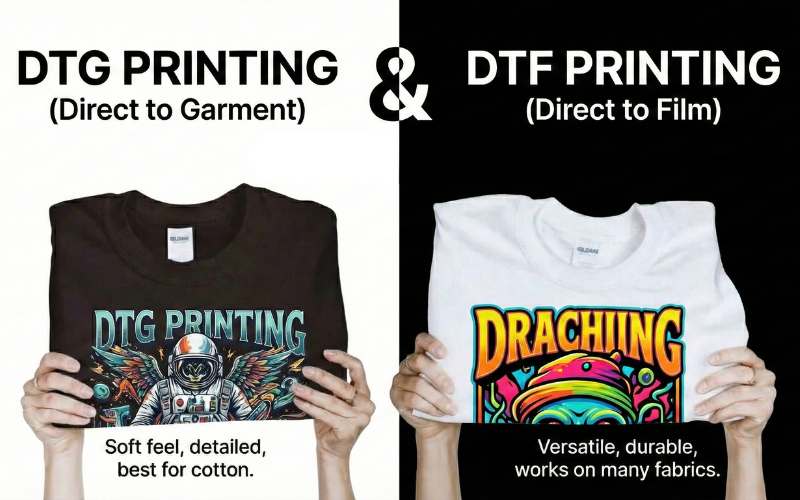
DTF and DTG are the two most popular printing techniques. If you are torn between these two and don’t know which one to choose for your designs, our article can help you pick a side.
Both techniques come with their unique features. To know which is the best choice for you, it is essential to understand the difference.
What is DTF Printing?
Direct-to-Film printing is a technique where designs are printed onto a special transfer film using heat-transfer inks. A thermos-adhesive powder is then applied to the printed design, after which it is heat-pressed onto the final fabric, creating a durable and vibrant print that works on polyester, cotton, fleece, and blends. The printing technique is known for its versatility.
How does DTF Printing Work?
DTF printing is a process that involves multiple steps. It creates very durable and vibrant prints. The steps of the printing process include-
-
Creating a Design
Before starting with the print, you need a graphic design software to craft a digital image. -
Printing on Pet Film
The design is then printed on a film made of PET (polyethylene terephthalate). A DTF printer is used for the printing process. -
Powder Application
While the ink is still wet, we use a special adhesive powder. When heat is applied, the powder activates and acts like an adhesive, bonding the design firmly to the fabric. -
Curing and Heat Press Transfer
The film is heated to activate the adhesive, after which the design is transferred from the PET film onto the fabric using a heat press at high temperature and pressure. -
Peeling and Finishing
We then carefully peel off the film to reveal vibrant, high-quality print on the garment.
DTF printing is the preferred choice for business owners who want to print on a wide range of fabrics.
What is DTG Printing?
Direct-to-Garment fabric printing is another printing technique that is used to print on fabrics. In this process, ink is sprayed directly onto the fabric, giving us scope for full-color and detailed designs. In this fabric printing process, the ink bonds with the fibers that leads to a breathable and soft print that feels like a part of the cloth.
The printing process is ideal for natural materials, such as cotton and bamboo.
How does DTG Printing Work?
This printing process requires fewer steps. Here is the printing process we follow0
-
Preparing the Design
Prepare and optimize a digital image of the design to be printed on the fabric. -
Pretreatment of the Fabric
We then treat the clothing piece with a special solution to ensure proper ink absorption and bonding on the fabric. This is an essential step, especially if it is a dark colored fabric. -
Printing
At PrintPapa, we use an inkjet printer to directly apply the design onto the fabric. First, we apply white ink onto the fabric (if required), and then follow it up with other colored inks. -
Curing
Our next step is to place the fabric under a conveyor dryer or heat press to dry. This sets the ink on the fabric strands.
What are the Differences between DTG and DTF Printing?
Both printing methods contribute the best in their own way and also differ in many ways. Let’s take a quick look at them.
a. Fabric Options
Some fabrics are more acceptable for DTG printing, while others are suitable for DTF printing because of the different ink applications used for each. DTF works on various fabrics, including cotton, nylon, fleece, polyester, and fabric blends. No matter the material, the print won’t be affected. Hence, you have more product choices to design.
When it comes to DTG, know that it is ideal for natural fabrics like bamboo, linen, cotton, or other such natural fabrics. This is because the ink binds with the fibers of the natural fabric better than synthetic fibers. So, the options are a little restricted.
b. Print Complexity
When it comes to the complexity of the print, the DTF process is unmatched. It supports fine art, full-color designs, graphics, photos, and a lot more. The prints that come out are sharp and realistic. Thus, the print closely matches the original design. DTF print allows you to print gradients. But you must keep in mind that the base of the print is white ink, which can impact the transparency or a gradient of the design.
With DTG, too, you can get colorful graphics, photos, designs, and more. They are vivid and detailed. However, keep in mind that the fabric can soak up the ink that can have an impact on the design’s clarity. Also, it might be tricky to print gradient when it comes to DTG. Thus, keep them limited and ensure the design is adjusted accordingly.
c. Quality
The choice between DTG and DTF printing can directly influence the final product. The former is excellent for designs with dark color depth and a softer finish. When the ink gets absorbed into the fabric, the print appears like a part of the garment. DTF print sits on top of the fabric, such as a thin decal or film with a smooth texture. Thus, they are great for vivid and bright colors.
DTG prints offer good results for all kinds of designs, but DTF printing works better with smaller designs, so that the print does not appear too stiff or thick upon wearing.
d. Color Vibrancy
The DTF printing process uses primary CMYK colors and a white ink base. So, each design will be vivid and vibrant, regardless of the fabric type or color. DTG printing might also depend on CMYK color to print all design and have a white ink underbase, but only if the designs is being printed on colorful or black garments.
In DTG printing, as the ink is jetted into the fabric directly, it can soak up some color. Hence, the print’s vividness depends on the absorbency of the product and can vary between various product types. However, printing on some challenging garments might not come out as bright as DTF printing.
e. Eco-Friendliness
If you are looking for a sustainable printing method for your garment designs, DTF printing is the best choice. This technique ensures printing one-off so that you do not have to worry about some printed garments staying unsold. When you are able to make products on demand, you don’t have to stress about overproduction. The ink used for this printing process is non-toxic and water-based. Hence, they are eco-friendly. It uses recyclable transfer film. Thus, the printing process leads to no waste.
DTG is also eco-friendly. The waste generated in this printing process is minimal. It enables one-off prints. So, you can avoid overproduction as you can print orders on demand.
f. Production Time
Printing time is important when choose the best printing process. Due to the two-step curing process, DTG printing is a tad slower than DTF printing. Before ink curing, the print supplier should cure the DTG pre-treatment solution. This takes longer when a forced-air dryer is used instead of a heat press.
However, DTF printing requires single curing. Moreover, DTF printed materials are made to bond with the design using a heat press instead of an air dryer. This speeds up the process. Working with a pay-on-delivery provider like us can help you keep the manufacturing time down when time is of the essence.
g. On-Demand Fulfilment
Both DTF and DTG printing are good for on-demand fulfilment. This means you can choose to print just one or multiple items, and the cost will not change. However, if you place a bulk order, you can enjoy a discount.
Direct-to-garment and direct-to-film print products are just made after you and your customers order them.
How to Choose the Right Printing Method?
After you have explored each printing method in depth, it might already be clear to you that each offers incredible results and is suitable for many. But each offers a different printing outcome. Here are the factors to consider to understand if DTF or DTG printing is right for you.
a. Business Size
If you own a small business, it is essential that you are flexible and look for a bigger return on investment. With DTG, you can create detailed designs on light fabrics without having to place big orders. Thus, it helps if you have to test out new ideas or provide customized clothing to your customers. But DTF printing works on different fabrics, such as nylon on polyester. It helps you cater to the needs of different customers.
As both printing options offer print-on-demand, it lowers financial risk. It allows small businesses to test out customers’ interest without hoarding and helps them grow steadily.
b. Environmental Factors
If you or your business care about the environment, DTG is a greener choice. Since it uses water-based inks, it is much faster and creates lesser waste. Moreover, DTG offers POD. It lets you avoid overproduction.
Even though DTF is becoming eco-friendly with the use of biodegradable and recyclable materials, it is not as eco-friendly as DTG yet. Its synthetic powders and films create waste. However, certifications show that both methods are safe and durable.
c. Fabric Options
If you have to print on different kinds of materials. DTF is a better choice. It works on leather, cotton, polyester, and also on even surfaces such as plastic or wood. The process doesn’t require the business to pre-treat the fabric, making the production process easier.
However, DTG only works well on natural fabrics. Even though it ensures great printing quality, it does not work with many materials.
So, whether you are printing bright colors or a unique surface, DTF is a better choice as it provides unmatched flexibility.
When to Choose DTF Printing
DTF is the right choice if you are selling apparel made from fabrics that work well with DTG.
Choose this printing technique if your designs are-
- Complicated and colorful
- Intricate and detailed
- With vibrant tones and sharp edges
But keep in mind that if your design covers a significant solid area, DTF might not be the right option for you. Moreover, the technique ensures the print sticks to the fabric layers- an oversized solid area might feel less breathable.
When to Choose DTG Printing
If you sell cotton, linen, or other natural materials, the DTG printing method is the best choice. With the printing technique, you can print garments or accessories, such as tote bags. Thus, you have enough choices.
Even though DTG prints can create small details, they are not as crisp as DTF. But for bold designs and everyday apparel, this is a great choice. DTF prints are long-lasting and ideal for printing larger designs since the prints are durable.
At PrintPapa, we help you choose the perfect printing method for your fabrics, designs, and order sizes. We understand the differences between DTF and DTG to ensure your product looks and feels great.
Frequently Asked Questions
Which Print Lasts Longer: DTG or DTF?
DTF prints outlast DTF prints because of the resistance to fading or cracking. Even though DTG prints are vibrant and tend to wear out more over time, especially with inappropriate care.
Is DTF Printing Suitable for Dark Fabrics?
Yes, it is. DTF printing is working great on dark fabrics. The white underbase layer offers opaque and vibrant results, even if you have the darkest material.
How Long Does a DTF Print Last?
DTF printing is long-lasting and doesn’t fade or crack even after several washes. To take good care of your DTF prints, follow the instructions given on the garments and avoid washing them in hot water, as the design can develop small cracks. Also, washing and ironing it inside out makes it last longer.
Is DTF Printing Worth It?
Yes, DTF printing is worth it because of affordability, durability, and adaptability. They are perfect for businesses looking for quality and long-lasting prints on different textiles.
Do DTF Printing Transfers Crack?
DTF printing transfers do not crack or fade even after several washes. To ensure your DTF prints last longer, wash and iron the garments inside out. Make sure that you do not wash them in excessively hot water, as the design might develop small cracks.
Do DTF and DTG Printing Use the Same Ink?
Both DTG and DTF use water-based inks. However, the printing process is different, and the inks feel or act differently. While DTF inks settle on top of the fabric, DTG inks get absorbed into it. Hence, you get different printing outcomes with each printing method.
Which Printing Method has Faster Production- DTG or DTF?
Usually, DTF is faster as a printing process, especially if you are printing in bulk. The transfer process ensures that the designs are prepared and applied rapidly. But DTG needs more setup time, including curing and pre-treatment.
What is the Drawback of DTF Printing?
The primary drawback of DTF is that it is not recommended for printing on larger areas. That’s because it can make the apparel feel heavy and rigid. As a matter of fact, DTF printing can feel initially, but it will wear off after a few washes.
Which is More Affordable- DTG or DTF?
DTF printing is more affordable for larger orders because of lower material costs and the ability to print on different fabrics. But it does require more ink. DTG, on the other hand, can be cheaper for smaller orders as it needs less setup. It is a suitable option for personalized and limited quantity prints.
Is DTF Printing an Eco-friendlier Option than DTG?
Generally, DTG is eco-friendlier because it uses water-based inks and doesn’t require added adhesive powders. DTF requires extra material, like adhesive powders and PET films. These things can increase waste.